AI sustainability keeps getting framed around the wrong question: does a local LLM use less electricity and water than ChatGPT or Claude?
The sharper question is: how many frontier-model calls are we wasting on tasks a smaller on-device model can already handle?
ChatGPT and Claude are powerful cloud systems backed by large data-center infrastructure. A local LLM running on a laptop is smaller, more constrained, and usually less capable. But it's also closer to the user and avoids the data-center compute and cooling footprint of that individual request.
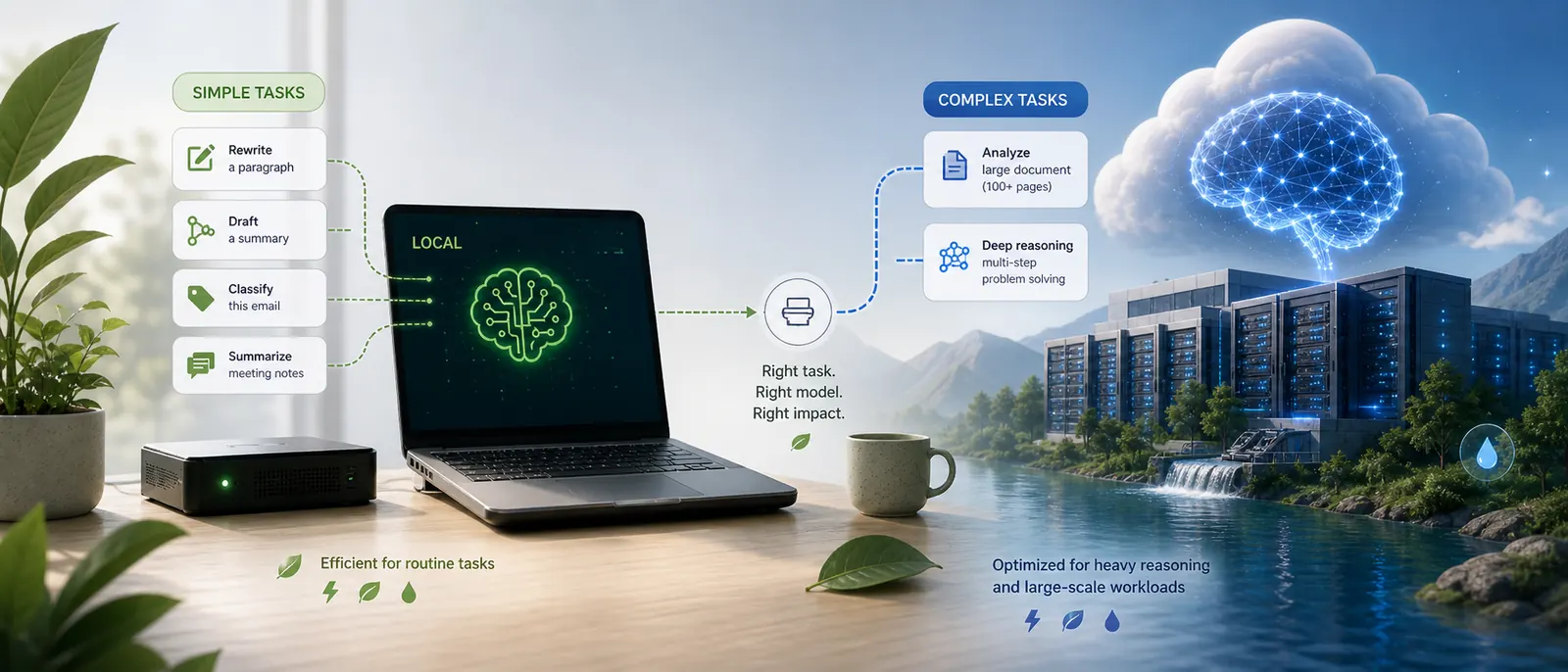
Local LLMs almost never beat frontier AI. But many everyday AI tasks don't need frontier AI in the first place. Rewriting a paragraph, drafting a commit message, classifying a note, summarizing a meeting excerpt: these rarely require frontier-scale reasoning. If a small quantized model handles the job on-device, sending it to a cloud model is unnecessary compute.
The numbers we're working with
The environmental footprint of a single prompt looks small in isolation. That's why the debate gets noisy, and why methodology matters.
Sam Altman has stated that an average ChatGPT query uses about 0.34 Wh of electricity and roughly 0.32 mL of water. That post doesn't provide a full measurement methodology, and averages hide variation across model type, context length, output length, and reasoning mode.
Epoch AI's independent estimate puts a typical GPT-4o query at around 0.3 Wh, but emphasizes that a 10,000-token input could reach ~2.5 Wh, and a 100,000-token input could approach 40 Wh.
Google published one of the more detailed first-party measurements: the median Gemini Apps text prompt in May 2025 consumed 0.24 Wh, generated 0.03 gCO₂e, and consumed 0.26 mL of water under a methodology that includes accelerator power, host CPU and DRAM energy, idle capacity, and data-center overhead. A narrower accounting boundary would have produced 0.10 Wh, which shows how much the methodology itself matters.
Anthropic hasn't published a comparable per-query figure for Claude.
The factual baseline: we don't have a clean apples-to-apples comparison of local versus cloud inference across the same tasks, hardware, and accounting boundaries. Which actually makes the case for local AI more precise, not weaker, because it forces you to argue from workload fit rather than blanket claims.
AI inference is becoming an infrastructure problem
AI is moving from occasional experimentation to persistent usage: coding agents, document assistants, internal copilots, always-on productivity tools.
The IEA projects that electricity demand from data centers will more than double by 2030 to about 945 TWh, with AI as the primary driver. A 2025 study in Patterns estimates AI systems' water footprint could reach 312–765 billion liters in 2025, while stressing that disclosure remains inadequate.
Local LLMs matter here not because they replace frontier AI, but because they reduce avoidable demand. Every simple task handled on-device is one fewer request sent to a remote inference fleet.
Small on-device models are now a serious and fast-moving category. Google's Gemma 4 ships edge variants at 2.3B and 4.5B effective parameters with 128K context under Apache 2.0. Alibaba's Qwen 3.5 small series (0.8B to 9B) targets phones and embedded systems, while Qwen 3.6 offers a 35B MoE with only 3B active parameters per token, making it practical on a single consumer GPU. NVIDIA's Nemotron 3 Nano packs multimodal understanding (vision, audio, text) into 4B parameters for Jetson and RTX hardware. Common local stacks (Ollama, llama.cpp, LM Studio, Apple MLX) make running any of these straightforward on consumer hardware.
The electricity case: three conditions
A local model saves electricity when three conditions hold:
- The task is simple enough for the local model's capability.
- The model runs efficiently on existing hardware (not a 70B model thrashing swap).
- The user doesn't retry repeatedly or escalate to cloud anyway.
The third condition matters most. A weak local model that produces bad answers wastes energy through retries, and a small model is greener only when it's good enough.
The simplest energy estimate is marginal Wh = (load watts − idle watts) × runtime hours. A 4-bit quantized 8B model on an M-series MacBook might draw 30W above idle for 20 seconds: 0.17 Wh. A 70B model on a workstation GPU might draw 250W for 60 seconds: 4.17 Wh. Both are "local." One is efficient. The other may be worse than an optimized cloud query.
Watts and tokens don't tell you much. Watt-hours per accepted answer does. Google's Gemini paper is a useful counterweight: optimized cloud inference can be highly efficient because of specialized accelerators, batching, and utilization.
Water: real advantage, bounded scope
Water accounting is where sustainability claims get sloppy. AI-related water use has two components: direct cooling at the data center, and indirect water consumed in electricity generation. IEEE Spectrum notes that the indirect component can make up 80% or more of total water use.
On-device inference avoids the direct data-center cooling water for that request. But it isn't water-free. Your laptop still draws electricity, and that electricity was generated somewhere with its own water footprint. The defensible claim: local LLMs avoid direct data-center cooling demand while shifting the electricity-related footprint to your local grid. Less sensational than "local AI uses no water," and actually defensible.
Quantization cuts energy use by up to 79%
A 2025 edge-inference study evaluating 28 quantized LLMs found that q3 and q4 variants reduced energy consumption by up to 79% compared with FP16, while reducing latency by up to 69%. The same study found accuracy trade-offs, especially for reasoning-heavy tasks.
This trade-off captures the local AI story in miniature. Quantization makes inference greener, but it can reduce quality. The engineering task is finding the smallest quantized model that reliably completes the workload, not chasing the largest model that fits on your machine.
The sustainable pattern: a workload routing table
If you accept that local isn't always greener and cloud isn't always wasteful, the practical question becomes: which tasks belong where? Here's how we think about it:
| Task | Local | Frontier cloud | Why |
|---|---|---|---|
| Rewrite a short paragraph | ✓ | Usually no | Short context, low complexity |
| Draft a commit message | ✓ | Usually no | Local quality is sufficient |
| Classify support tickets | ✓ | Rarely | Good fit for small models + caching |
| Summarize a one-page note | ✓ | Sometimes | Escalate only if accuracy is poor |
| Summarize a 100-page document | Maybe | Often yes | Long context changes the equation |
| Debug a distributed systems failure | Maybe | Often yes | Reasoning depth justifies frontier compute |
| Analyze regulated content | No | Specialist workflow | High-stakes output needs stronger controls |
The pattern that emerges: local LLMs win when the task is frequent (thousands of small requests per day, not one-off queries), short (fits a small context window), low-risk (drafts, classifications, first-pass work), and good enough locally (no retry loops that end at ChatGPT anyway).
They lose when the model is too large for the hardware, the task requires long context, or the cloud alternative is highly optimized and well-utilized. A 70B model running slowly on a workstation can consume more electricity per useful answer than a smaller cloud model in purpose-built infrastructure.
The measurement gap in AI sustainability
Most "green AI" claims fall apart under scrutiny because they don't measure the right thing. The number that matters is Wh per accepted answer: how much energy did it take to produce output the user actually kept? A model that sips power but generates garbage isn't efficient. If someone regenerates three times and then pastes the prompt into Claude anyway, the local model burned energy for nothing.
The AI Energy Score initiative has started publishing relative efficiency ratings for models based on GPU Wh consumption across specific tasks, which gives teams a starting point for comparison. But even those numbers need local context. The same model on a renewable-heavy grid in Norway has a different carbon and water footprint than the same model on a coal-heavy grid in Poland. Multiply your local kWh by your grid's water intensity (L/kWh) and carbon intensity (gCO₂/kWh) to get a realistic picture. Until vendors publish standardized per-task energy figures with consistent accounting boundaries, teams that want honest sustainability claims will need to do this math themselves.
What to stop saying
"A local LLM is always greener than ChatGPT or Claude" keeps showing up in blog posts and conference talks. It's wrong. Optimized cloud inference on specialized hardware can beat a poorly matched local setup on energy per useful answer. The same goes for "local AI uses no water," which ignores the upstream water footprint of whatever electricity your laptop draws. And any claim that "one AI prompt uses exactly X amount of water" is meaningless without specifying the model, data center, cooling system, prompt length, and accounting boundary.
A better claim, and one you can actually defend: for short, repetitive, low-risk tasks, a small quantized on-device model reduces unnecessary cloud inference and avoids the direct data-center cooling footprint of those requests.
Right-sized inference as a practice
The future of AI won't be purely local. Frontier models are too useful, and many tasks genuinely need them. But it shouldn't be frontier-only either. Sending every rewrite, summary, and classification to a state-of-the-art cloud model is technically lazy and environmentally sloppy.
The sustainable path is right-sized inference. Run simple tasks locally. Prefer small models before reaching for large ones. Quantize where quality allows. Keep context tight and cache repeated work. Measure energy per accepted answer. Escalate only when the task earns the cost.
Local LLMs aren't a sustainability guarantee. They're a sustainability tool. Used correctly, they reduce electricity demand, avoid unnecessary cooling, protect privacy, and cut latency. Used carelessly, they waste energy, degrade quality, and prop up false green claims. The greenest model is the smallest one that reliably completes the job, and in a world where AI demand is scaling into an infrastructure problem, that matters more than ideology.